Monday, 1 August 2011

A Case for Nicklas Bendtner

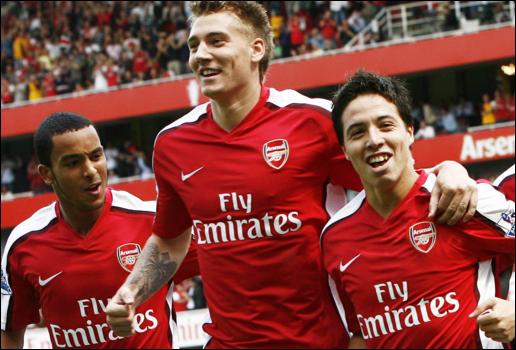
It has been made no secret that Nicklas Bendtner is keen to secure a move from the Emirates and he seems close to doing just that. The Danish centre-forward has not travelled with the club or taken part in any pre-season friendly matches so far
Ask your average Arsenal fan and they will tell you that they’re very happy for Bendtner to be leaving. However the young Dane’s contributions to the Arsenal cause have been far less woeful than his reputation suggests. Often accused of arrogance or ‘over confidence’ by his own fans, Nicklas Bendtner was left in a no win situation at the club. The player said he wanted to play every game; he was criticised. He said he could score goals; he was criticised even more. Tell me, what more do you want a young forward to say?

The reason Bendtner struggled to score was because he was played out of position for the majority of his time at Arsenal. More often than not he was to be found out on the right hand side putting crosses into the box. Yes, the tallest Arsenal player on the pitch was putting the crosses in to the likes of Arshavin, it's laughable really. However, when he was played in a more central role, most notably in the 2009-2010 season, when Robin Van Persie was injured, he scored several important goals for the club; namely, a 94th minute winner against Hull at the Emirates to keep The Gunner’s in the title race. A header from a cross, funnily enough.
Yet, it seemed that nothing could win him over with the fans. Constant criticism followed by several relatively fruitless efforts on the right wing eventually ground the player down and with the arrival of Marouane Chamakh he has probably felt forced to look elsewhere for the chance to play regularly.
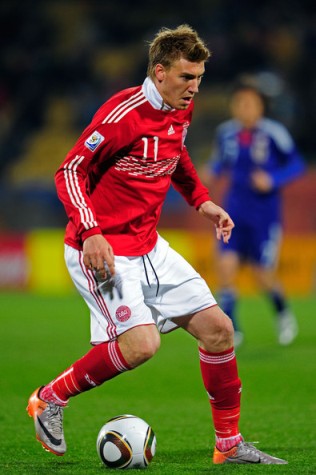
Just to put things into perspective slightly, Bendtner has scored 45 goals from 156 appearances and Robin Van Persie has scored 97 from 230 appearances. That’s an average of 3.4 games per goal for Nick, compared to 2.3 for Robin. Now, just to clarify, I am not suggesting that Nicklas Bendtner is on the same level of Robin Van Persie the point of the stats are just an attempt to show that perhaps some of the ill-feeling directly towards Bendtner was a bit hasty. He also played a big part in securing Denmark a place in the 2010 World Cup; a massive achievement for a 20-year-old.
Before the signing of Chamakh, Bendtner was Arsenal's archetypal centre forward who could be deployed as a change of strategy when their patient passing football was falling short of the mark (See: Ibrahimovic's role for Barcelona). Yet, he was rarely used as an actual plan B, as in, Arsenal would never change their style to suit their target man and the whole thing was a bit limp. More of a bad fit than Bendtner being a bad player.
Talk of a potential buyer for Nick has been coming from Portugal and there has reportedly been several clubs in contact for him, it’s now down to the player and his agent which is his father to choose the most suitable club.

Sunday, 12 June 2011

Are England's Players in Need of a Better Football Education?

Today’s England team are often criticised for failing to live up to expectations on the international scale. Many ponder the reasons for this given that the teams do so well on the European scale, although not with a full squad of English players, but many other European domestic teams share a similar line of success as their country. For example, the success of Barcelona and Real Madrid, AC Milan and Inter Milan, Bayern Munich has something of a correlation with their respective countries prospering in European or World Cups. Does anyone think that England’s successes are in correspondence to Manchester United/Arsenal/Chelsea’s? It seems that England players fall short of the mark compared to their continental peers; are they need of a better footballing education? England’s international success does not match the likes of Manchester United’s success in Europe.
It seems blasphemous to suggest that an Englishman would not receive a substantial education in football. However, when you put aside the notions of ‘heart’ and ‘pride’ on the pitch and think about it seriously, many of Europe’s top teams give a far better all round education to their students of the game. The current Barcelona squad, into which Pep Guardiola has instilled a Cryuff-inspired philosophy, have been widely admired. What most people forget is that it is not simply beautiful football but it has to be perfectly married with an abundance of discipline and understanding of the game.
Graduates of the Barça school La Masia are taught to think of the pitch divided up into eight boxes; all of which must be occupied by at least one player at all times. If a player sees an empty box he must fill it in order to ensure that the team are always in a good position to defend if they should lose the ball. Even when on the attack they are aware of the possible need to defend; this relies on, not only great discipline and awareness of what the team is doing as a whole but also, an in-depth knowledge of each individual player’s function within the team.

Each player knows what part their role plays in the context of the team, Sergio Busquets said recently: “Part of my role is to shuttle between the defence and attacking lines to make sure the ball circulates well and quickly. Often this pivotal position starts the play. Defensively I'm also an intermediate between our back four and the midfield and I try to mark and press so I can isolate the opposition striker from their midfield.”
Obviously, Barcelona raise the bar high for other teams but this understanding is not uncommon in Europe. Steve McClaren revealed that during FC Twente matches the players left out of the squad or players from the youth team would be asked to write a report on the match as they watch it, ready for submission after the game. Thus, broadening their understanding of the match and identifying the various team formations, changes in tactics etc.
I get the feeling that if you asked an English player what went wrong during the game and why they had failed to win you’d probably get a response along the lines of, “Well, they just wanted it more than us.” There is no doubt that the desire to win plays a part but you cannot expect players to flourish against more intelligent footballing opponents if they don’t understand the game inside and out.


Monday, 23 May 2011

Is the Respect Campaign failing to Gain Any Respect?


The FA and UEFA have implemented a “Respect campaign” in recent seasons with, let’s be honest, minimal effect. The role of such a movement is to address the issue that players’ are too colourful with their language and too brash with their general attitude towards refs.

A noble attempt, you may say, in trying to dignify the game and prevent the players from coming across as bad role models to young children, since it is the case today that the players as labelled delinquent, bad tempered potty-mouths. Not to say that in some cases this isn’t true but I think the majority of players don’t find it difficult to respect the referee if he earns it.

That’s the thing about respect; it has to be earned. Not only can it not be brought about by a respect campaign, it certainly cannot be brought about when it is not deserved and the truth of the matter is that some referees just don’t deserve respect.

A couple of weeks ago The Secret Footballer column in the Guardian discussed referees and not the players behaviour towards them but the referee’s behaviour towards the players. Obviously no names were mentioned but it was confirmed that this player had been spoken to improperly by the referee and that it’s not uncommon to hear the referee’s using profanities as much as the players.

How can the campaign itself be respected and sincere when the referees, whom this is supposed to benefit, are dishing out their fair share of abuse?

I think the refs could help themselves more with their actions and reactions on the pitch than any limp campaign, not matter how much it is pushed. I have seen, on several occasions, a player will run over to the official be it referee or linesman simply to ask why the decision was made. It is fair to say that in many cases the players are too aggressive but the official usually attempts to ignore them which sparks further fuel to the already overheated player. Rather than be confident in their decision and explain themselves they back away from confrontation and refuse to engage with the players.

By not commanding respect on the pitch and using the same language which could get players sent off, the referees are making a mockery and a hypocrisy of the respect campaign causing players and fans to deplore the whole situation even more.

Wednesday, 27 April 2011

Clasico Tres: The Ugly One


Lionel Messi continued his spectacular form by scoring his 51st and 52nd goals against Real Madrid which broke the deadlock in this tense derby and then put the match beyond the home side. The breakthrough came after Barça substitute Afellay put in a dangerous low cross which Messi connected with at the front post after getting ahead of Sergio Ramos by an inch.

It took 75 minutes for Barcelona to score and it came about after Madrid went down to ten men. It’s the fifth time in a row that a Mourinho team has had a man sent off against the Catalans and Pepe becomes the seventh player sent off in the last six meetings between the clubs; five for Real and two for Barça. Jose then practiced what he seems to preach by getting sent to the stands after unacceptable comments made to the fourth official.

The match had a Mourinho-esque feel about it in the sense that it lacked dignity, respect and was a downright shameful portrayal of the two clubs, or maybe it was an accurate representation. Yes, Messi’s goal was wonderful but lest we forget that the precious demi-God reacted angrily to a challenge and tried to elbow someone in the leg earlier in the match, which was conveniently brushed over. Pepe’s red card was slightly harsh but the situation had reached boiling point and the Barça players were not going to let this one go as Dani Alves was taken off on a stretcher. He returned to the pitch soon after.

Whether Madrid were happy about it or not, in the first half Barcelona dominated possession and Madrid seemed at ease to let them do so and wait for a slight mistake to pounce on. Pepe, Alonso and Diarra pressurised the Barcelona front line and forced them back. Madrid struggled to keep the ball however, and when they did regain possession it was usually for a short spell. Casillas came to his side’s rescue when Xavi was played through the middle delightfully by Messi.


The German referee, Wolfgang Stark, was submitted to serious scrutiny every time he blew his whistle; from the managers, commentators and protests from the players and fans. The match was again deterred from the footballing side of things even by half-time when a melee ensued when a few players came together in a slight tussle which resulted in Barcelona’s reserve ‘keeper, Pinto, being sent off.

The second half saw Madrid take the game to Barcelona with more determination to attack and break the Catalans makeshift defence down; Puyol was playing on the left with Mascherano and Pique in the middle. However, it was to no avail. Cristiano Ronaldo had a vague chance when he found himself pushed away from goal and opted for a shot instead of looking for a runner to square the ball to.

After Pepe was sent off the game was again in Barcelona’s control. Adebayor’s presence was felt but it was too late for los blancos. As it stands, Real Madrid have a mountain to climb at the Camp Nou next week and they will have to do that without Sergio Ramos (suspended), Pepe (suspended) and their manager who will be ordered to the stands again.


Pep Guardiola stated that Mourinho had one the verbal war but reminded us all that a football match was to be played and that's where he would make his move, not in the press conference. He will consider Mourinho the winner of the battle but it looks like the war is his. For the neutral it was a frustrating match and one that prompted many questions about why this match had been hyped as a ‘footballing’ spectacle and not for what it was; a cynical war between two sides whose players play out the same rivalry on a stage already set by its history.


Real Madrid (4-3-3): Casillas; Arbeloa, Albiol, Ramos, Marcelo; Diarra, Pepe, Alonso; Ozil (Adebayor 45), Ronaldo, Di Maria. 4-3-3

Barcelona (4-3-3): Valdes; Alves, Pique, Mascherano, Puyol; Xavi, Busquets, Keita; Pedro (Afellay 70), Villa (Sergi Roberto 89), Messi.

Monday, 25 April 2011

Ajax 4-1 SBV Excelsior: Show Down For Eredivisie Still On.


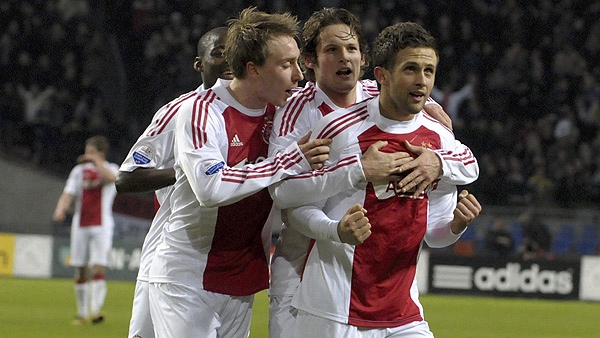
Lorenzo Ebecilio scored a brace to ensure that Ajax keep up with FC Twente in the mouth-watering Eredivisie title race. The game was rounded off with a superb overhead kick by Siem De Jong making it four, whilst the second came from Christian Eriksen. The Amsterdammers sit just one point behind league leaders Twente on a weekend that PSV dropped points after they were humbled in 3-1 Rotterdam by Feyenoord, finishing the game with 10 men to boot.

Ajax dominated possession but there was a nervy air around the stadium, something us Arsenal fans can relate too and when SBV Excelsior equalised out of nothing to make it 1-1.  Big defender Daan Bovenberg equalised for the away side just after half time and I wonder how many Ajax fans almost gave up the title hopes there and then.  But as the news (and video clips) of PSV’s failings filtered through the ground the Ajax faithful were galvanised yet again; huge cheers rang around the arena and the players responded with three goals and real belief.

De Jong’s final goal was a beauty, a perfectly timed overhead kick from 10 yards out in the 92nd minute. The real beauty was that he would have had time to take a touch and bring the ball down but instead he chose to stick it to Excelsior and boot the boot in the only way Ajax know how; with flair. The third goal was largely thanks to Serbian forward Miralem Sulejmani who lifted the ball over the defence straight into the path of Ebecilio who finished off for his second of the evening. The pass was a real treat for the football connoisseur.

Sulejmani had a fantastic game in the creative forward role under the watchful eye of a former Ajax great in the same position, Tottenham man, Rafael Van der Vaart. The Serb was a constant threat for the wavering Excelsior defence, not often did they play long balls but when he did they were precise and usually consisted of involving wide players, stretching the opponents defence. In fact, so rarely was a long ball seen that even the Ajax goalkeeper insisted on playing the ball short to his full-backs rather than take a long range goal kick.

Given the crowd's chants of “Ajax kampioen!” it is safe to say that this lot are confident. If they win their next match away to Heerenveen and FC Twente don’t lose to Willem II then it will be a winner-takes-all situation at the Amsterdam Arena when Ajax and Twente face each other on the last day of the season. A draw may not be good enough for Twente because they still have PSV to worry about, despite dropping points at the weekend they can still sneak in and win the title if the win their games and other results go their way.

Wherever your loyalties lie it’s going to be one hell of a match on May 15th in Amsterdam, cameras at the ready; it’s going to be a photo-finish.

Friday, 22 April 2011

Clasico Dos: The King's Cup

The cup final. Not many changes made: pinto for valdes, adriano for puyol arbeloa for albiol, ozil for benzema. Pepe still playing further forward.

Mourinho stuck to his guns and came out victorious. Pointed out by Johan Cryuffn in the negative, as being a manager for trophies and not football... I couldn't see any Madristas complaining.

Despite dropping the cup under the bus, there was no feeling that Madrid didn't enjoy every second of their first copa del rey for 18 years.

The momentum was with Madrid, chances were almost equal but Madrid had the edge and when players such as Affelay came on late there was no real feeling that they'd win it for the Catalans.
It says a lot that los blancos fans were applauding intently after the league game which almost terminated their title challenge from the relief of not being beaten by their biggest rivals.

It was a cup game which was intensified by the rivalry of the clubs which was intensified ten fold by the upcoming champions league games. There had to be a winner and I suppose both teams would prefer to lose on penalties. Ronaldo scored the only goal from open play in the two fixtures to secure the win for Real in extra time. Now, the pressure is (wrongly) set upon Mr. Guardiola in the media and the tide is turning in Real's favour.

Mourinho's pragmatic nature seems to be instilled in his squad and, unfortunately, I think they are the favourites for the champions league tie. Mourinho has already beaten Pep's Barca over two legs in last seasons CL when he won it with Inter Milan, can he do it again to his growth club with their rivals? I can't imagine there's anything he would enjoy more.

Sunday, 17 April 2011

El Clasico Uno: Real Madrid 1-1 Barcelona; Mourinho's tactical changes.


The thing about Jose Mourinho is that he quickly learns his lesson and last night's performance against Barcelona was a good example of his tactical prowess. Beaten 5-0 at the Camp Nou, Mourinho’s biggest defeat ever as a manager must have cut him deep and it won’t be forgotten. However, despite his Catalan rivals being top of La Liga with an impressive eight-point lead the momentum has shifted seemingly at the right time for Madrid.

An impressive come back last night has giving his substantial squad a boost, especially with ten men; his ten-man strategy paid off, it seems. The first of four encounters saw a particularly defensive Madrid side take the field with Pepe playing defensive midfield along with Alonso and Khedira in the middle. This allowed Barcelona little time and space on the ball; something they enjoyed in the reverse fixture. The first half was fast paced yet lacked many real threats and, uncharacteristically, both sides’ passing was not as sharp as usual.

With the second half came both goals, both from the spot. Ronaldo and Messi respectively converted for their teams.  The pivotal point was the dismissal of Raul Albiol for his foul on David Villa in the box. Mourinho was left with a big decision to make and his substitutions rescued a point for Real. Instead of moving Pepe from his midfield position back to the centre of defence he brought on Arbeloa who went to right back, allowing Sergio Ramos to move into the middle keeping Pepe in the space between the defence and midfield. This allowed Ronaldo, Ozil and Adebayor to go forward with Khedira linking everything together.

Despite the fightback from Real, Barcelona still remain top and strong favourites for the championship. Next comes the lesser of all the clashes between the two and Real have the squad to put out a stronger team if Barcelona feel like they need to rest players. The team who lift the trophy on Wednesday will receive a massive boost of confidence for the all-important Champions League ties.

 
Madrid: Casillas, Ramos, Albiol (sent off), Carvalho, Marcelo, Alonso (Ozil), Pepe, Khedira, Di Maria (Arbeloa), Ronaldo, Benzema (Adebayor).

Barca: Valdes, Alves, Pique, Puyol (Keita), Adriano (Maxwell), Busquets, Xavi, Ineista, Pedro (Affelay), Messi, Villa.